18 AUGUST 2024
NOTE: THIS IS PROVIDED AS A GUIDE ONLY
Paris minus its suburbs is referred to as Paris intra-muros, and is made up of 20 districts, or arrondissements. You can always know which one you are in simply by looking at the street signs. Above the name of the street you will often see a number followed by “Arrt.” for “Arrondissement”. A person’s address is also a giveaway, since the last two numbers of the postcode indicate the arrondissement. So, for example, 75003 is a 3rd arrondissement postcode, while 75018 is the 18th.
A further division is the left bank (rive gauche) and right bank (rive droite) of the Seine. This means the area south (left) and north (right) of the River Seine. Traditionally, the rive gauche is seen as more artistic, bohemian, and student-friendly, while the rive droite is more bourgeois and sophisticated. However, some areas within the rive droite remain working-class districts, popular among immigrants, families, and students.
If you look at a map of Paris, the arrondissements spiral out in the form of a snail shell. The 1st, 2nd, 3rd, and 4th arrondissements are the most central, and also the most expensive areas to live in. The numbers of the arrondissements then climb as they spiral out from the center, finishing with the most affordable in the far northeast (the 19th) and east (the 20th) of the city.
All of central Paris is well-connected to the dense public transport system, which includes buses, metro lines, fast trains to the suburbs, and trams. Whichever arrondissement you choose, you will be close to essential public services, including schools, doctors, and hospitals. But each arrondissement differs somewhat in terms of the atmosphere, population, and even crime statistics. Therefore, it’s worth getting to know them a little better before choosing a place to call home.

1st and 2nd arrondissements: centre of Paris
The heart of Paris is primarily shops, offices, and tourist attractions with relatively few apartments. In the 1st arrondissement, you will find the Louvre and Tuileries gardens, the shopping hub of Les Halles, and the monstrous metro changeover at Chatelet. The 2nd arrondissement is relatively small. At its heart is the Bourse, the former stock exchange.
The area is easily walkable, making this a good choice for anyone wanting to be close to the business district. From here, you are also very well connected by public transport to the rest of the city and even the suburbs. At the Chatelet and Les Halles transport hub, five metro lines and two RER train lines will whizz you across the city in no time… as long as you can find your way around their underground maze!
However, with few restaurants or grocery shops available in the evening, it’s not necessarily the most practical area to live in. Bars and other services largely cater to tourists and passing professionals. As a result, it’s not a very warm or intimate district, and it lacks a neighborhood feel. Not to mention that real estate prices here are some of the most expensive in the city.
It may also be worth noting that the richest areas of Paris are also where most personal thefts occur. For instance, the rate of theft of items such as handbags and phones is 16 times higher in the 1st arrondissement than in Paris overall. As for the 2nd arrondissement, it registers the highest rate of burglaries in Paris.

3rd and 4th arrondissements: Le Marais
The 3rd and 4th arrondissements are found just to the east of the first two. They are also in the very center of the city, but have a very different feel. Here, you will likewise find some major tourist sites including Notre Dame Cathedral and the Picasso Museum. But despite this, the 3rd and 4th arrondissements have a very local vibe. They are packed to the brim with a diverse community of Parisians, mingling in local cafés, bars, and clubs.
The Marais, an area that takes up a good chunk of the 4th arrondissement north of the Seine, is known for the city’s best Jewish restaurants and bakeries on the rue des Rosiers. Another much-loved local spot is the Marché des Enfants Rouges, in the 3rd arrondissement. Open every day but Monday, this local market was built in 1615. You’ll find locals grabbing a coffee, sitting down to lunch, or buying fresh produce in the large market hall and adjoining outdoor area.
If you can afford the house prices here, it’s a central, vibrant, and wonderfully authentic place to live and experience Paris at its best. Bear in mind, however, that owning a car is not a good idea since parking in central Paris is expensive and difficult to find. Most people walk, bike, or use the metro and buses to get around.

5th & 6th arrondissements: Latin Quarter
Hugging the left bank of the Seine, the Latin Quarter has a rich expat history. It was home, most notably, to Ernest Hemingway and Gertrude Stein. You can still sip an (expensive) coffee at Les Deux Magots, where they wrote and debated alongside the likes of Scott Fitzgerald and Jean-Paul Sartre. Then, you can browse English books at the Shakespeare & Co bookshop.
The Latin Quarter is a joyful mix of students, foreigners, and wealthy Parisians. Depending on which street you take, you might come across a row of arthouse cinemas, contemporary art galleries, fancy boutiques, or affordable Asian cuisine. It’s a vibrant, if rather pricy, neighborhood. Rents are on the higher end, and the 6th arrondissement, especially around Saint-Germain, boasts some of the most expensive real estate for purchase. In addition, if you live here, forget about driving. Parking is a nightmare, but the best that Paris has to offer is within walking distance.

7th arrondissement: Eiffel Tower district
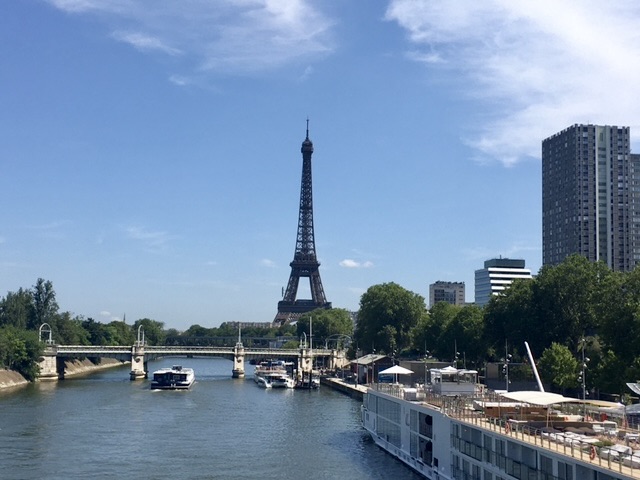
There’s something very cinematic about catching a glimpse of the Eiffel Tower from your balcony, as you may be able to do if you decide to live in the 7th arrondissement. It is both a rather grand and rather residential district. You will be close to impressive sites including the Invalides Museum, the Ecole Militaire, and the National Assembly. It is also home to the Bilingual Montessori School of Paris, the American University, and the American Church of Paris.
For expats with children, this can be a convenient and quiet neighborhood to have as a base. All the basic necessities are there, including grocery stores and outdoor markets, and you won’t have to go far for an evening stroll along the Seine. On the other hand, it is not a particularly vibrant area for nightlife, and local bistros cater largely to tourists and business lunches. The 7th is also pricy.

8th and 9th arrondissements: chic Paris
This large area of the right bank encompasses the Champs-Elysées, the Parc Monceau, and the Saint-Lazare train station (in the 8th), and stretches from the Opéra up to Pigalle (in the 9th). It is an area scattered with museums, grand squares, galleries, luxury stores, government offices, and auction houses. While the beautiful Parc Monceau is packed with local families on the weekends, most of the area caters to a professional population.
However, the northern part of the 9th arrondissement, roughly from Place de Clichy to Anvers, merges into the red light district. This area draws tourists and those in search of all forms of nightlife, but definitely fewer families. As such, real estate here is rather more affordable than in the very chic southern sections of these two arrondissements.

12th arrondissement: sporty Bercy
The 12th arrondissement is in the east of Paris, running along the Seine’s right bank from the Canal Saint-Martin, and encompassing the huge and leafy Bois de Vincennes beyond the périphérique (the high-speed road that belts around Paris). It is ideal for families and anyone in search of outdoor activities away from asphalt. The Parc de Bercy also has a skate park and live sports arena, while the Coulée Verte, a raised park, is popular with runners and cyclists.
New developments in this area mean a more diverse housing stock that includes modern and attractive social housing. Bercy Village offers a vibrant local feel with a cinema, shops, restaurants, and cultural events. Young couples and families are also drawn to the slightly more affordable real estate.

13th, 14th, and 15th arrondissement: residential southern Paris
Drawing a strip along the south of the city, the 13th, 14th, and 15th arrondissements largely represent a local, authentic Paris away from the tourist crowds. The 13th includes a student hub by the Seine, with a university campus and the national François-Mitterand library, a Chinese quarter near Olympiades, and the vibrant Butte-aux-Cailles district. In the 14th, you’ll find some of Paris’ most leafy neighborhoods around the Parc Montsouris, as well as the Montparnasse cemetery and train station, surrounded by shops, cinemas, and restaurants. Finally, the 15th is maybe the most quiet and residential of the three, dotted with small parks and cafés where locals gather.
These areas of Paris have some of the lowest crime rates in the city. Having said that, major rail hubs often draw petty criminals, and the Gare Montparnasse area has a high rate of underage delinquents compared to the rest of Paris. Most neighborhoods, however, are very safe and popular with families, but increasingly pricy too. Some areas of the 13th though, especially Chinatown, are still affordable.

16th and 17th arrondissement: swanky western Paris
The 16th and 17th arrondissements are located in the far west of the city. In the middle is the sprawling Bois de Boulogne, which has recently welcomed the impressive Louis Vuitton art foundation. The park itself is inhabited by joggers and families by day, and famously by vice once the sun sets. The area is a little far from the city center, and thus generally less popular with the younger population, since it also offers little in terms of nightlife.
The 16th, however, is rather attractive to sports enthusiasts. It’s where you’ll find the Parc des Princes soccer stadium, the Roland Garros tennis grounds, the Jean-Bouin rugby fields, the Longchamp horse racetrack, and the Polo de Paris golf club. In addition, expats are drawn to the international community that gathers around bilingual institutions such as the Eurécole and the International School of Paris.
Aside from that, these arrondissements are known for being the home of Paris’ bourgeoisie. They are largely peaceful and prosperous residential neighborhoods with expensive amenities. Apartments vary from spacious family dwellings to tiny maid’s quarters populated by students. The housing stock is varied, with everything from new apartment blocks to 17th-century town houses. Overall, home prices here are pretty average.

20th arrondissement: more affordable Père Lachaise area
The 20th arrondissement is located in the very east of the city. It is the last and also one of the most affordable arrondissements in terms of real estate prices. The area has a more diverse architecture than in the city center, and especially more low-cost housing. As such, many young families have been moving here in recent years.
Right in the middle is the Père Lachaise cemetery. It is the area’s biggest draw, where you will find the tombs of many celebrities including Jim Morrison, Edith Piaf, and Oscar Wilde. The northern part of this arrondissement, around Télégraphe and Belleville, are often deemed less safe.
Source: Expatica.com
Photographer: Martina Nicolls
